
The National Museum of African American History and Culture (NMAAHC) hosts the immersive exhibition “Afrofuturism: A History of Black Futures,” captivating visitors since March 2023. I find myself virtually sitting across from Kevin Strait, a curator at the NMAAHC, whose profound connection to Afrofuturism infuses into our discussion. As we embark on our conversation, it becomes evident that Kevin’s curation of the exhibit transcends professional duty, evolving into a profound journey fueled by his own personal intrigue and scholarly zeal.
Discovering Afrofuturism

Photo Courtesy of Kevin Strait
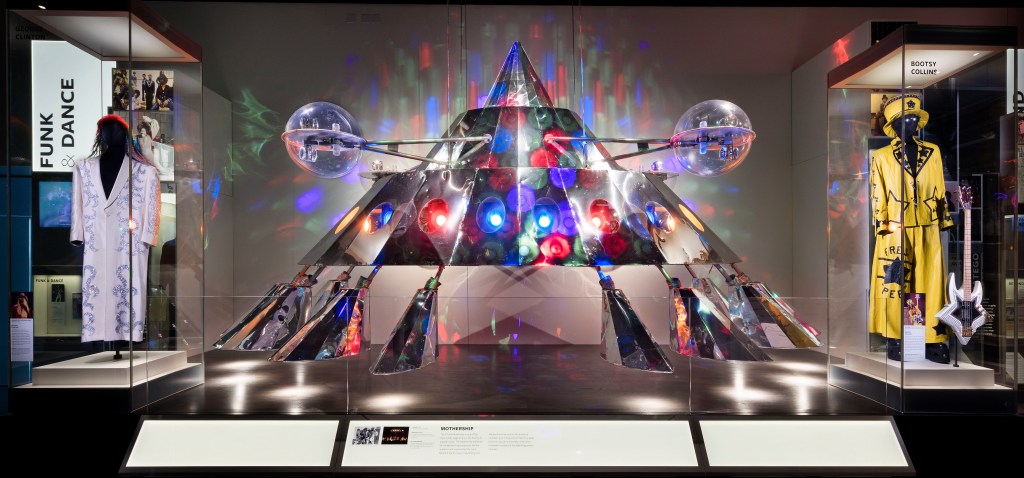
Kevin’s journey into Afrofuturism began long before the exhibition’s inception, sparked by a fascination with funk music, Black rock musicians and the cosmic universes created by artists like Parliament Funkadelic from a young age. “I’ve been a fan for a long time, and I’ve seen them play live and everything, and was always fascinated not just by the music, but by sort of the universe that they created with their songs; the sound of their music, with the costumes that they wore, but also this whole connection that Parliament Funkadelic had with space. I’d never really conceptualized music in that kind of way before, where the general premise around a lot of their songs was about escaping or freeing your mind, but within the cosmos,” Kevin says.
As he dove deeper into Afrofuturism through his graduate studies and pivotal moments like acquiring George Clinton’s P-Funk Mothership for the museum, Kevin’s vision took shape over years of research, collaboration and scholarly exploration. “I had been sitting with this topic for a number of years prior to the exhibition opening,” he says. “I was brought on to work at the museum in 2010, and I worked on several of the permanent inaugural exhibitions, including ‘Musical Crossroads.’”
Crafting Afrofuturistic Realms
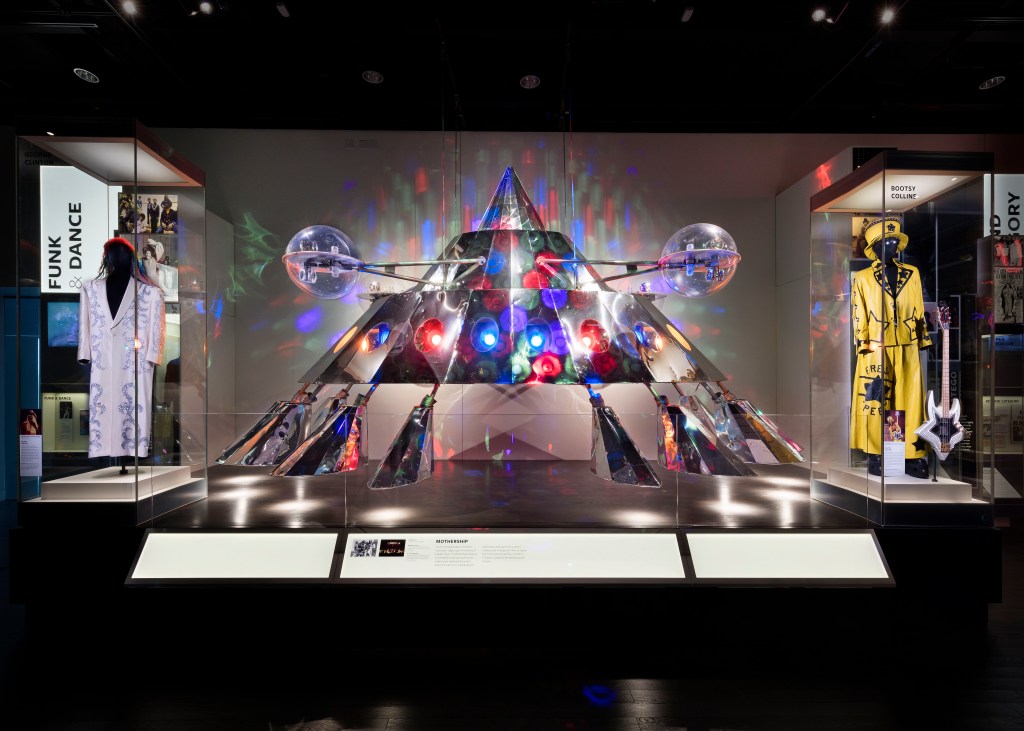
Photo Courtesy of Douglas Remley/NMAAHC
Kevin, a music historian by trade, began considering Afrofuturism in relation to the museum’s collection in 2011. It wasn’t until 2018 that he began drafting the exhibition. However, the emergence of the COVID-19 pandemic forced him to pause working on the project. “It was really a years-long effort to sort of develop the ideas and also to think about which pieces of the collection could represent this idea of Afrofuturism,” he reflects.
Despite the challenges posed by the COVID-19 pandemic, Kevin’s dedication to curating the exhibit persisted, driven by a desire to explore Afrofuturism’s multifaceted expressions and historical legacies. “As we were collecting these kinds of pieces, I was thinking along the lines of how they could be displayed within the context of Afrofuturism. I was busy collecting, pitching and writing at the same time,” he says.
The process of curating the exhibit was an intentional endeavor, from designing sensory-rich environments to weaving together diverse narratives, Kevin and the NMAAHC team meticulously crafted an exhibition that invites audiences to engage with Afrofuturism on multiple levels. “In a way, the widespread expression of Afrofuturism was really one of the parts that was, in a sense, one of the most fun aspects about Afrofuturism to curate because you could take a look at it from a variety of mediums and different perspectives. I think a central focus of the exhibition was to identify the various modes of expression of Afrofuturism; about how it’s been a fixture and a constant, really, in African American life. The exhibit really gave me a lot of freedom to explore the various facets in which Afrofuturism has been expressed in our culture,” he explains.
Connecting Afrofuturist Themes
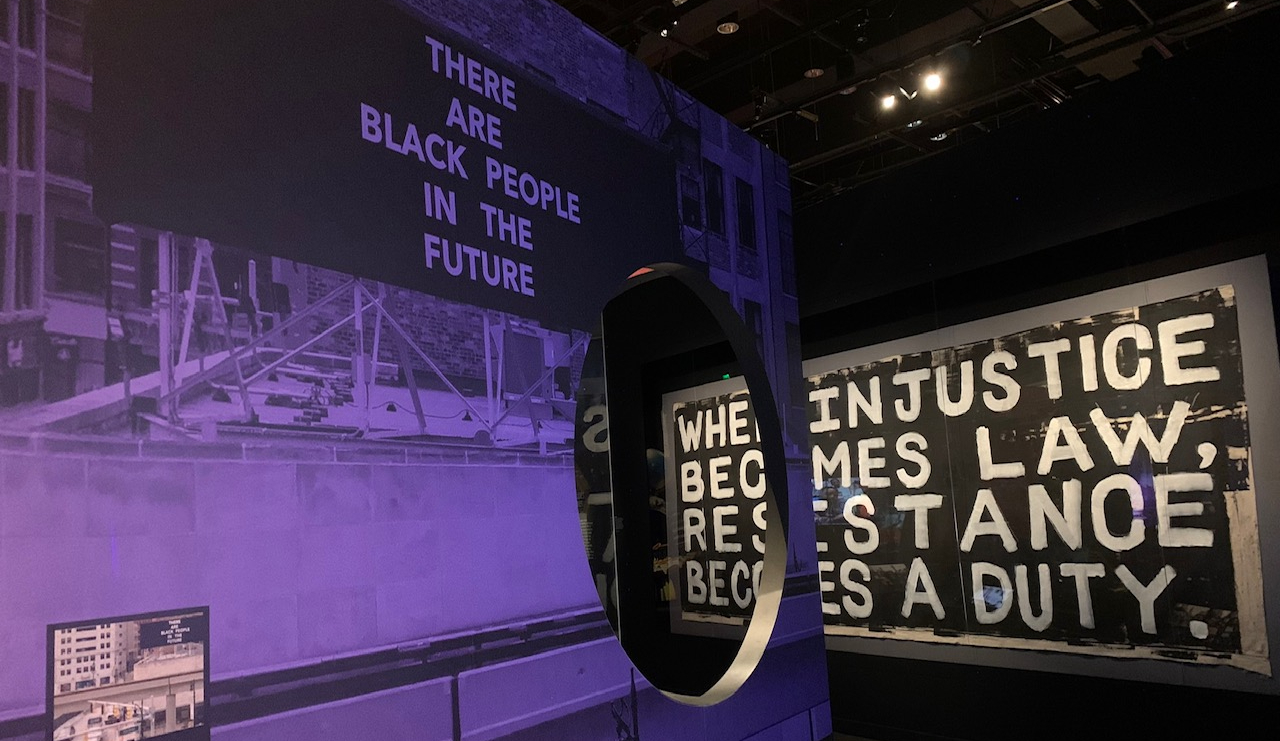
Photo by Makayla White
The exhibit charts a course through Afrofuturism’s multifaceted landscape, providing a linear roadmap for a nonlinear subject, Kevin says. At the exhibition’s outset, three vibrant video screens offer unique insights into Afrofuturist concepts. This portion of the exhibit contextualizes the subject, weaving in the stories of African legacies and astronomy, that serve as vital precursors to Afrofuturist thought. By laying this historical foundation, it sets the stage for deeper exploration, inviting visitors to travel through Afrofuturism’s expansive realms of music, art and beyond.
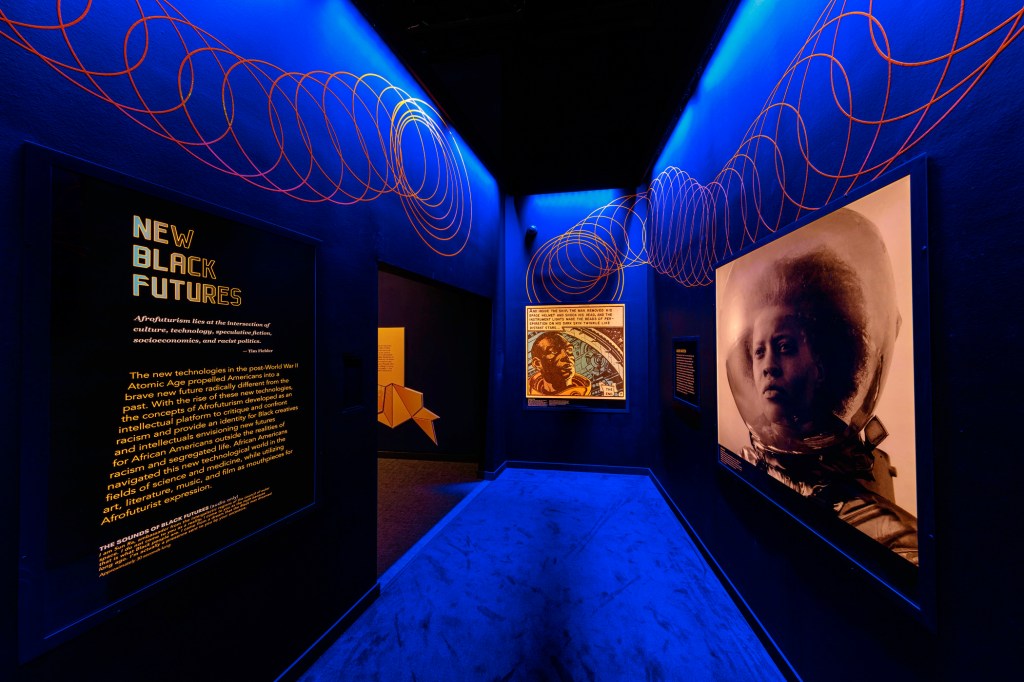
The first portion of the exhibit also transports visitors into the heart of a spacecraft lifting them off into a new universe. These carefully crafted portals act as gateways ushering visitors from one era to another. Kevin explains the amount of thought and attention that went into what he calls moments in the exhibition that include visual and sensory clues to help connect themes from one section of the exhibit to another. “So if we’re talking about Luke Cage being pelted with bullets, but being impervious to it as an homage and an Afrofuturist retelling of the events of Trayvon Martin’s life and death, we wanted people to understand that as they’re reading the text label, but to also visualize it and see the next section that deals with the Black Lives Matter movement and Trayvon Martin’s life,” Kevin continues.
Visual and Sensory Journeys

Photo by Rutha Howard
Every element contributes to an enriching and enlightening experience, allowing audiences to engage with Afrofuturism’s complexities with clarity and depth. When exploring concepts about Black thought and Black ideas, Kevin says it is important to have an environment that has an atmosphere in which people can really take a deep dive into their imagination.
He explains that the intent was to create this atmosphere where visitors were taking on this heavy topic with visuals and audio tracks to help support the exhibit’s narrative and help carry some of the weight of the subject matter. “I was thinking the entire time when I was developing the idea that this needed to be a sensory heavy, immersive experience. I wanted the audience to walk into what felt like almost a dreamlike atmosphere, where they were almost forced to utilize their imagination to kind of conceptualize this topic,” he says.
Through the exhibition’s exploration of themes like race as technology and Afrofuturist expressions in music, art and literature, Kevin encourages visitors to consider the broader implications of Afrofuturism on culture and consciousness. By distilling complex ideas into accessible forms, he sparks conversations and expands perspectives, inviting audiences to envision new possibilities for Black futures. “I wanted an exhibition that drew people in where people would feel comfortable walking around and taking on this complex topic, but with a smile on their face where they’re engaged in a way that it’s not focusing on the complexity, but in the ways in which Afrofuturism potentially connects to their own lives,” Kevin emphasizes.
Immersive Engagement

Photo by Rutha Howard
Rooted in three decades of dedicated scholarship and research, the exhibit is a physical representation of Afrofuturism’s influence. Kevin’s hope is for visitors to not only gain a deeper understanding of the term but to also grasp its profound impact. Uncovering Afrofuturism’s extensive history and symbiotic relationship with popular culture comes into view as another central focus. The exhibit serves as a place for African Americans to rediscover and redefine themselves within the museum. As Kevin aptly summarizes with the NMAAHC’s unofficial motto, it’s about “making a way out of no way.”
As visitors navigate the exhibition’s rich history of Afrofuturist expression, Kevin encourages everyone to approach the experience with an open mind and a willingness to explore unfamiliar territory. “It’s okay if you don’t have working knowledge of the term or if you’ve never really thought about Black expression or culture in these ways before,” he says. Whether admiring iconic artifacts like the Black Panther suit or tracing the evolution of Afrofuturism through historical and contemporary lenses, visitors can discover a deeper appreciation for Afrofuturism’s enduring relevance and cultural significance.
Kevin also invites visitors to explore some of his personal favorites on display. One such treasure is the custom electric ESP guitar owned by Vernon Reid, renowned for his groundbreaking work with the band Living Colour. For Kevin, witnessing Vernon and his bandmates craft a unique fusion of hard rock and metal during his youth left an indelible mark. It’s been fascinating for him to share this piece of history and explore how Living Colour and others have embraced Afrofuturism in their musical endeavors. Then of course, there’s the Black Panther suit. Although there was a lot of discussion about whether to put the iconic suit out front and center to draw people in, Kevin says he intentionally put it towards the end of the exhibit because it fit the narrative better.
Reflecting on Impact and Significance
“I think it’s just sort of integral to the moment we’re experiencing. We see broad aesthetic influence in our art today, but we also feel its impact in our culture when we see examples like Black Panther not only becoming a global phenomenon, but really in the ways that the character and the story represent notions of strength, agency, pride and connection. That sort of gives a sense of how Afrofuturism is now part of this collective way in which we analyze and interpret the Black experience. I think it’s central to the way we’re thinking about Black art today and the Black experience, too. It’s part of this larger conversation,” he says.
Kevin expresses that the journey of curating the exhibit has been a deeply personal and scholarly journey. With each passing year, his understanding of Afrofuturism has evolved, intertwining with personal discoveries and academic insights. From the juxtaposition of Henrietta Lacks and the Tuskegee experiment to the exploration of bodily autonomy in Afrofuturist literature, Kevin masterfully navigates complex themes to weave a cohesive narrative.
“It takes a while, sure. In my case, years, to really kind of sit with it and, like I said, write it out and to fully conceptualize how it could look, feel and sound,” he says.
Through meticulous scholarship and creative curation, he unveils the interconnectedness of diverse elements under the Afrofuturist umbrella. In distilling these profound ideas into exhibition form, Kevin challenges conventions and expands perspectives, offering a nuanced understanding of Afrofuturism’s importance. The impact of his work resonates deeply, enriching our understanding of cultural history and igniting imaginations for generations to come. Don’t forget to explore my comprehensive guide to “Afrofuturism: A History of Black Futures” for valuable insights and inspiration during your next museum visit.
How has your understanding of Afrofuturism evolved through encountering narratives like the ones showcased at the “Afrofuturism: A History of Black Futures” exhibit? What connections do you see between historical narratives, contemporary issues and speculative visions of the future within the Afrofuturist framework? Let me know in the comments below!
 The Beginner's Guide to Afrofuturism
Leave a comment