
In the vibrant heart of Washington, D.C.’s H St., there exists a culinary haven that defies traditional categorization. Bronze, the world’s first Afrofuturistic restaurant, stands as a testament to innovation and creativity in both cuisine and ambiance. Open for a little over a year with a staff of 32 individuals, the restaurant has become a unique space where culinary artistry meets alternative history. The visionary mind behind Bronze, Keem Hughley, illuminates the challenges, triumphs and unique journey into the realm of Afrofuturism.
The Bronze Byway
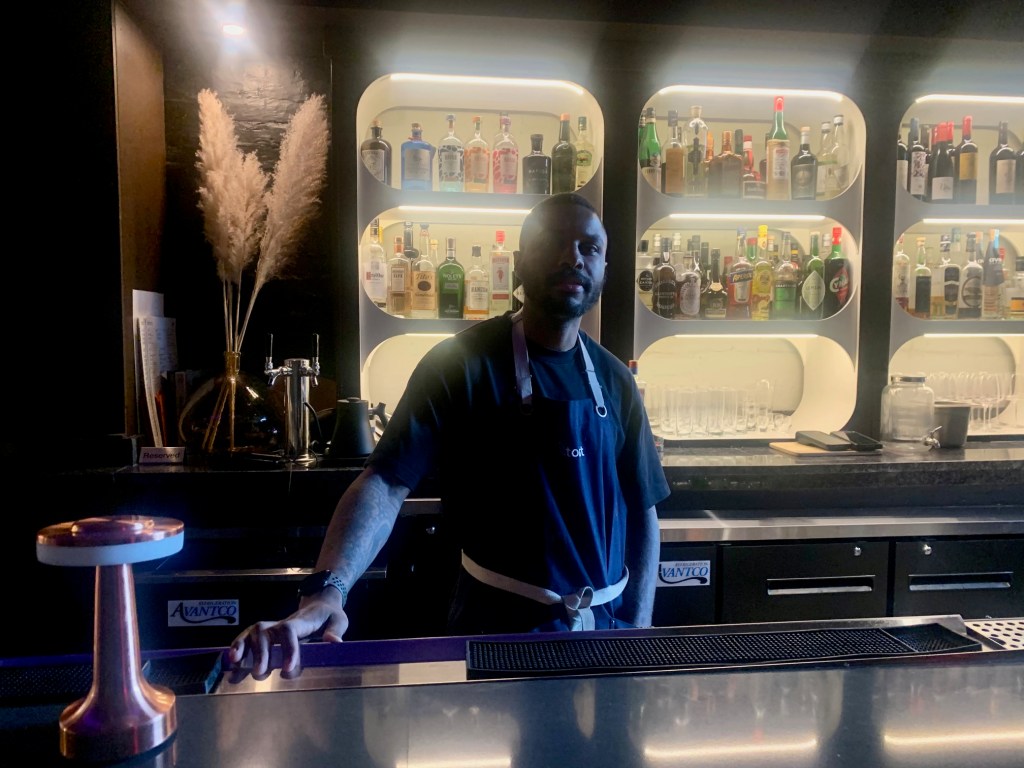
Photo by Makayla White
Keem’s path to Bronze began in the hospitality industry 17 years ago. His initial foray involved hosting parties at what is now The Wharf, a prominent restaurant hub in D.C., which laid the foundation for his subsequent decade-long journey in restaurants. “I wanted to open a restaurant before I found Afrofuturism,” he explains.
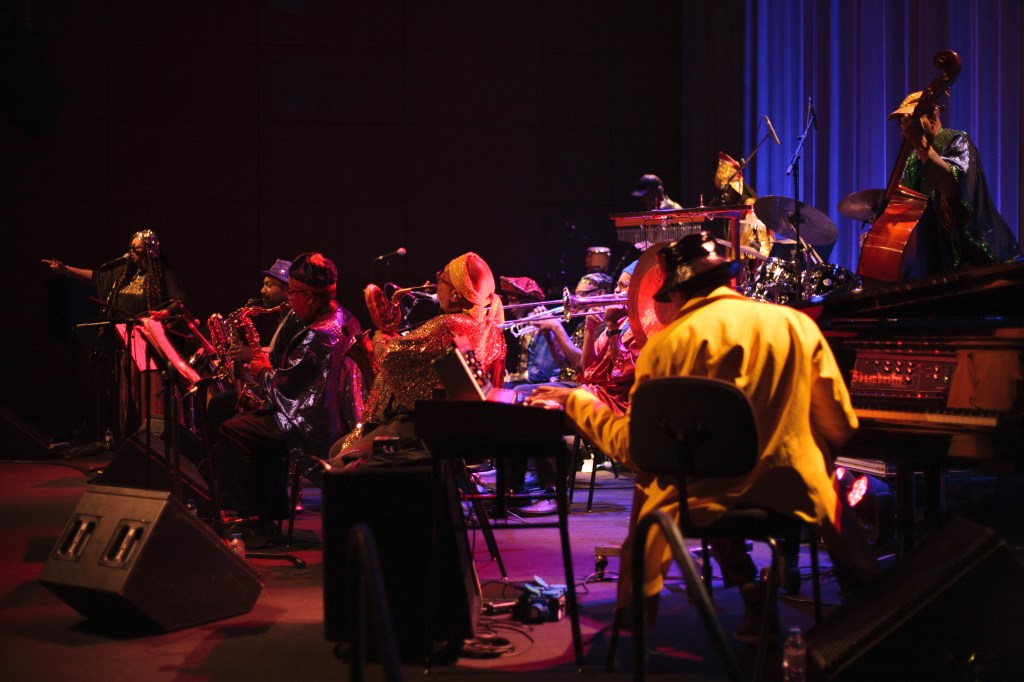
His first encounter with Afrofuturism unfolded through the pages of Ytasha L. Womack’s book, Afrofuturism: The World of Black Sci-fi and Fantasy Culture, serving as a catalyst for delving into a conceptually rich narrative for Bronze. Another pivotal moment occurred while he was watching the Arkestra perform before the restaurant officially opened.
“I realized after watching Sun Ra’s band play that I can do something outside of the box, and it still makes sense,” he says. Saffron and guinea sauce in their dishes for example, became hallmarks of Bronze’s innovative approach. Ingredients that might seem unconventional on paper, work together to harmonize seamlessly in taste.
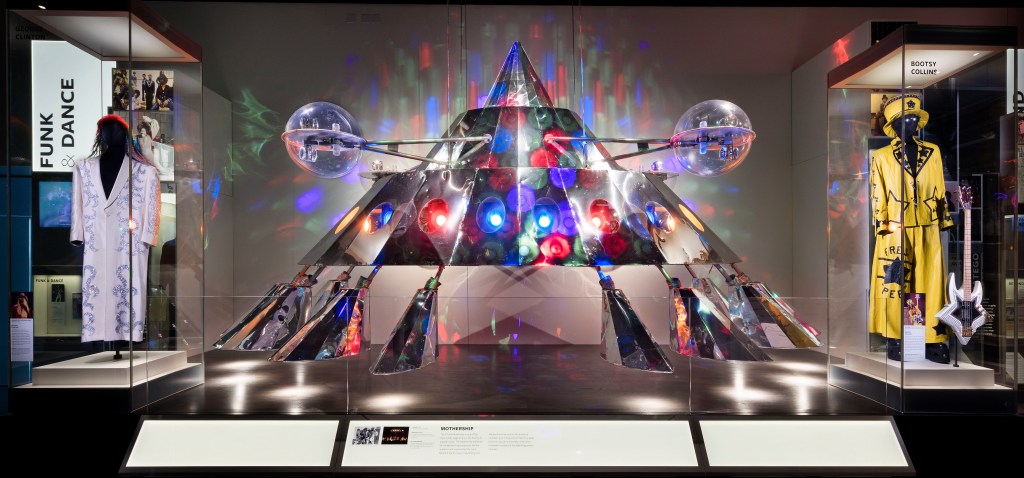
Sun Ra, John Coltrane and Ytasha L. Womack serve as Keem’s Afrofuturistic Mount Rushmore, with their influence permeating throughout the restaurant. He collaborates with Ytasha in real time on the vision and intention behind Bronze, describing her as the oracle. Keem also acknowledges the significant impact of Ryan Coogler – another one of his biggest inspirations – and the film Black Panther on his Afrofuturistic journey.
The Story of Alonzo
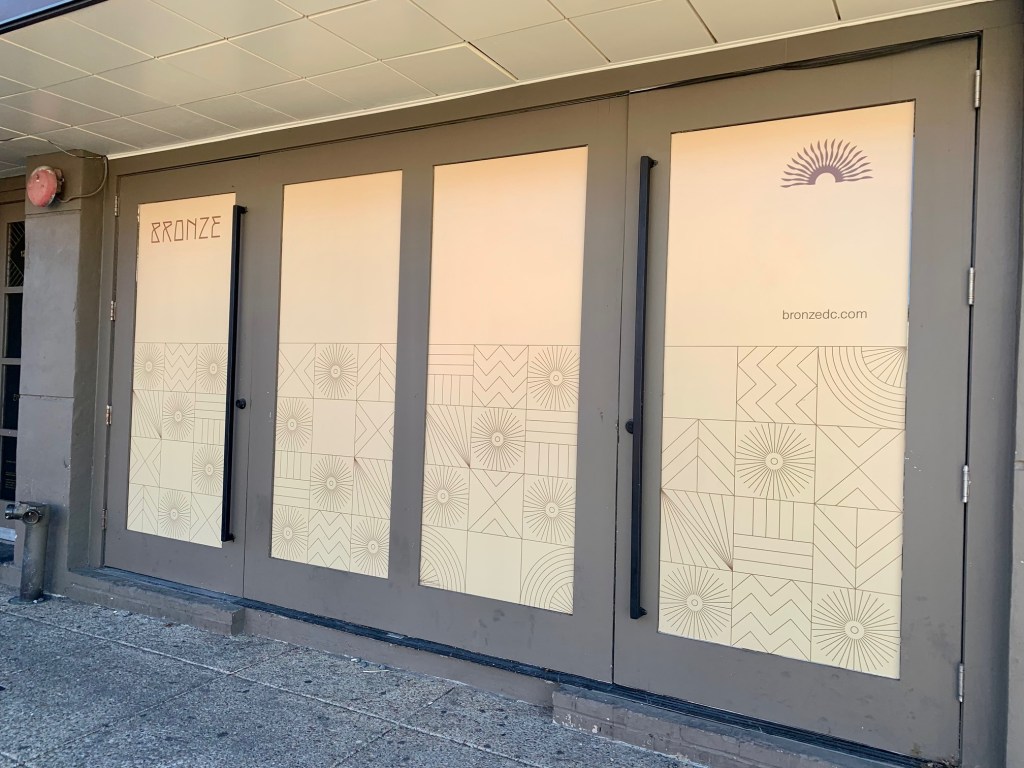
Photo by Makayla White
Keem elaborates on the inception of Bronze, detailing the evolution from the original concept of Bronze Table (the idea of what the table looks like for Black Americans) to the personified character, Alonzo Bronze. After reading Ytasha’s book and taking a Harvard disruptive strategy course, he realized that he needed to create a storyline rather than just a singular idea. That’s when he decided to turn the concept into a person.
The narrative envisions Alonzo (the name of Keem’s great-grandfather IRL) from the pre-transatlantic slave trade era, an eternal figure who traded spices and culinary techniques worldwide from the 1300s up until the present day at Bronze. “I imagine that he did this as a free man. I do not recognize the transatlantic slave trade in my story. I imagine that the people of Africa moved to the diasporas, not in slave ships. They moved on their own accord. We’ve created the world that we create under. When we create dishes, when we create the space, we’re creating from this alternative history,” says Keem.
Conceptualizing Culinary Futures
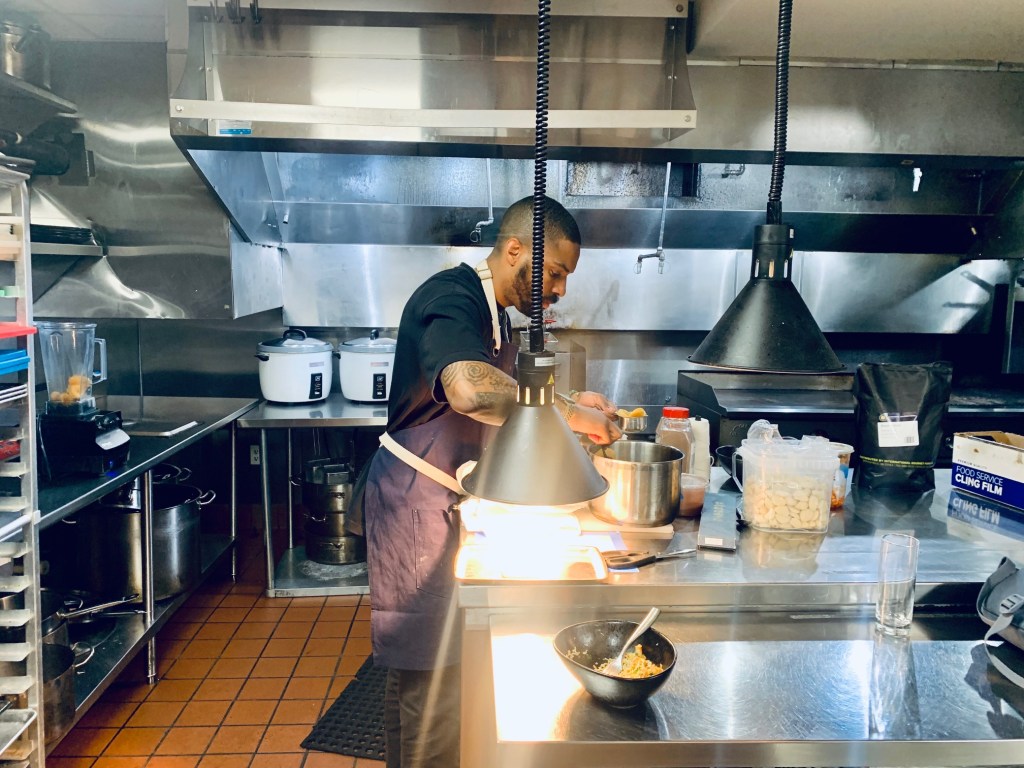
Photo by Makayla White
This alternative history is the foundation for Bronze, which echoes the spirit of its visionary forebearer. The collaborative force that initially drove Bronze involved key players like Toya Henry, Nadine Brown, Al Thompson and Drummond Projects. Toya, having worked at the restaurant in its early months, contributed to shaping its culinary identity.
Nadine, the sommelier, crafted a wine selection that complements the Afrofuturistic theme, while Al Thompson, translated Afrofuturistic moments and Black history into unique cocktails. Drummond, the architect, helped envision a world untouched by colonialism, influencing the design and ambiance of Bronze. Keem explains that throughout the creative process the team would listen to or watch Afrofuturistic moments and then create based on those experiences.
Afrofuturism manifests itself in Bronze’s culinary offerings through inventive combinations and elevated traditional dishes like their sweet plantain with spiced creme fraiche, grilled poulet with cashew bird’s eye glaze and a guava cheese donut with flavors of blood orange, honey and cinnamon. Keem highlights the braised oxtail and pappardelle dish, a labor-intensive creation combining techniques from Italian and Caribbean cultures.
Signature cocktails, such as the Lando Calrissian and Wild Seed, demonstrate Afrofuturistic storytelling, drawing inspiration from cultural moments like Star Wars and Octavia Butler’s novel of the same name. The second half of the cocktail menu, “The Most Unknown Known,” is dedicated to popular cocktails created by Black bartenders from the early 1900s up until the 1980s who received little if any credit for creating them. The culinary language for the space Keem explains, means respecting ingredients and people.
Visualizing the Space
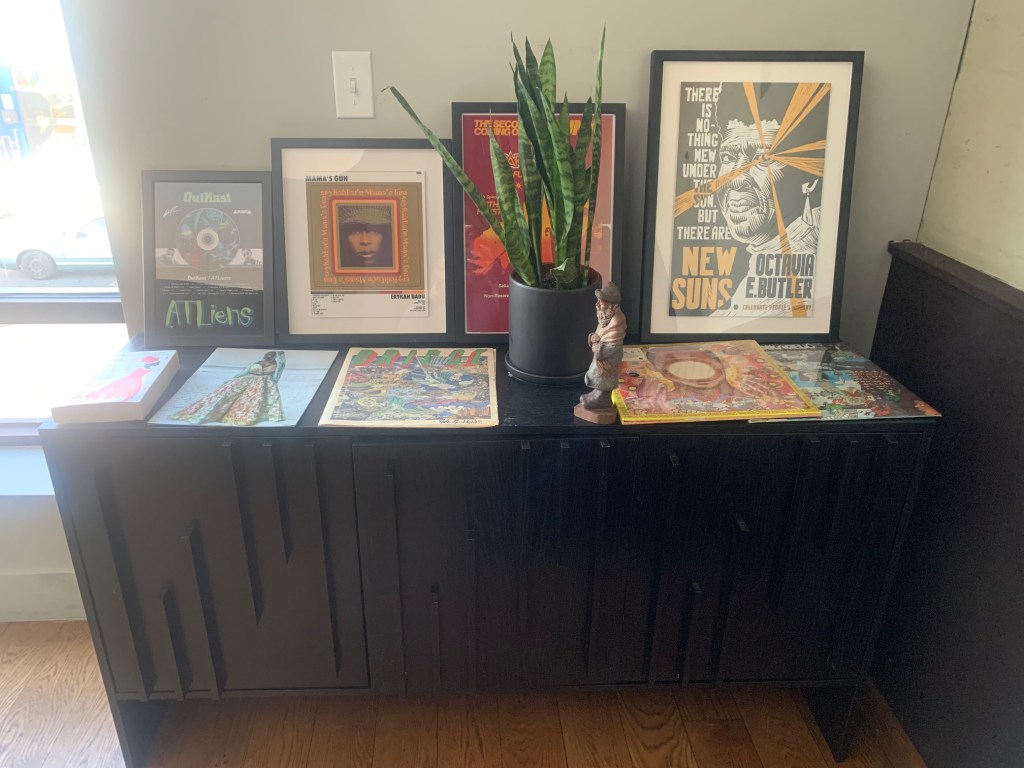
Photo by Makayla White
The interior of Bronze reflects Afrofuturism through subtle spaceship-like curvature, symbolism and clean lines. “We wanted to define what a building looks like that’s created by people that are from the African diaspora, but if their lens was not clouded by the transatlantic slave trade. There would be a lot of curvature. There would be soft tones. It would feel almost very calming. Like there’s no struggle in the architecture. So that’s what you’ll feel in our space,” says Keem.
Afrofuturist shrines are sprinkled throughout with a table featuring framed posters of Outkast’s ATLiens and Erykah Badu’s Mama’s Gun. A pamphlet from Ayana V. Jackson’s From the Deep: In the Wake of Drexciya at the National Museum of African Art lies alongside them. In another section, novels by Ytasha Womack and Octavia Butler frame one of the booths.
Working with local artists like APT 50 and Alabi Mayowa from Nigeria, the space aims to transport visitors into Alonzo Bronze’s lair and interpretation of the world. Alabi created the NFT artwork of Alonzo and his six counterparts who traveled with him throughout the ages and can be seen gracing the walls of the second floor.
Challenging Conventional Narratives
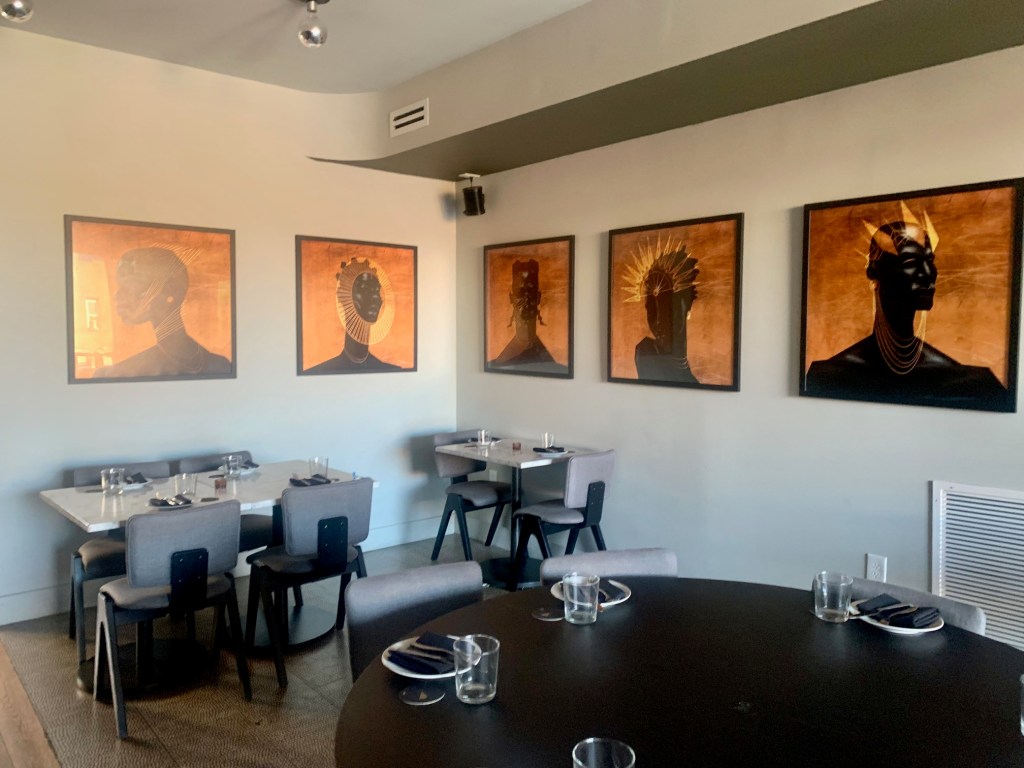
Photo by Makayla White
Introducing Afrofuturism into the culinary scene poses a unique set of challenges. Keem acknowledges the initial difficulty in categorizing Bronze on platforms, finally settling on the label of international cuisine. Being the first Afrofuturism restaurant in the world also meant educating patrons, a task Keem has taken on with zeal.
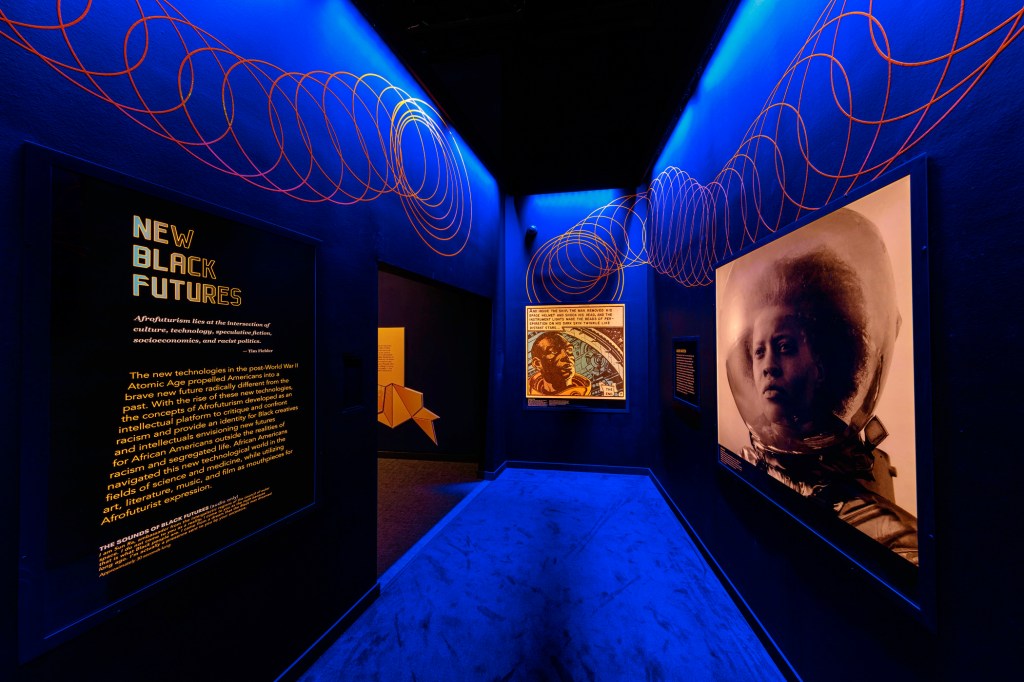
“In our first four months, there were a lot of people trying to tell us what it is and what they think of it. This is my singular idea of what Afrofuturism is. You can’t define that. For me, Afrofuturism is about us defining what our past and our future look like. Without Afrofuturism, in reality, it’s always been defined for us. This is why we have to use Sci-Fi to create outside of that lens,” Keem says.
Yet, the rewards have been profound, recently creating unique culinary experiences for world-class performers like 9th Wonder, Timbaland, Thundercat, Common and Stevie Wonder. Keem takes pride in what he calls the Bronze UberEats initiative, cooking for individuals who perform and inspire others at the highest levels. He also sold out an Afrofuturist dinner for Platform by the James Beard Foundation in NYC. The restaurant has garnered extensive media coverage since its opening, featured in publications such as Essence, DCist and notably, an especially cool piece in Luxeicon.
For Keem, the personal connection to Afrofuturism influences every decision. The ethos of the restaurant resonates in the warm experience and community-building. He reiterates the importance of respecting others by rejecting traditional restaurant hierarchies. His daily interactions, from preparing apricot jam for the wild pepper prawns to discussing champagne options with wine distributors and traversing the universe to get the word out about Bronze, reflect the dedication to cultivating a space where inclusivity thrives
Interstellar Connections
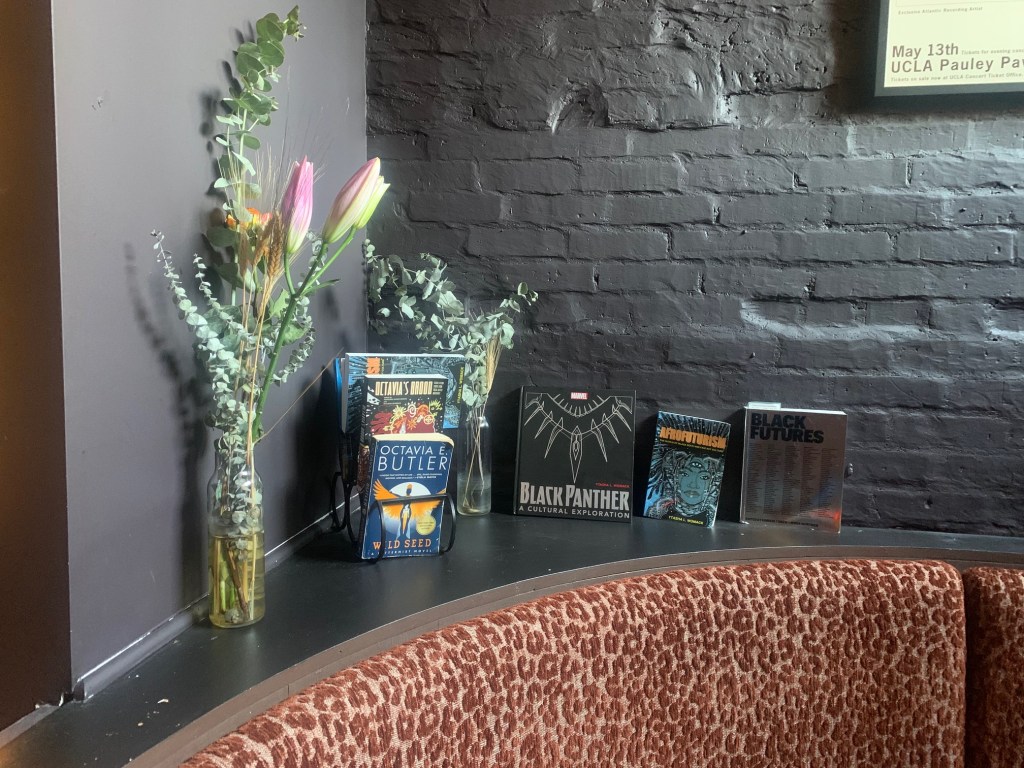
Photo by Makayla White
Afrofuturism, as Keem describes, embodies the idea of humanity, extending beyond the restaurant into personal relationships. “The thing I love most about Afrofuturism is that, to me, it’s an individual definition. Your idea of Afrofuturism and my idea of Afrofuturism is completely different. I mean, we may have the same throughline, but what me and Ytasha think may be two different things, and that’s the beauty of it. Alonzo Bronze is our world. It’s our story. Hopefully, people understand it and they appreciate it.”
Keem’s vision for Bronze becomes clear – a legacy of trust, respect and nourishment, where every customer leaves with a sense of having been part of something extraordinary. Beyond its physical space, Bronze aims to contribute to the broader conversation about Afrofuturism, fostering a freedom of creation without societal constraints. Keem envisions the future of Bronze having full sensory dinners in the next year or two, offering further interpretations of Alonzo’s travels. He also sees Bronze expanding to far-off lands like Los Angeles and Paris.
Bronze stands as a pioneering venture, blending culinary innovation with Afrofuturistic storytelling. Keem remains committed to redefining culinary norms and creating a space where the past, present and future converge in a celebration of culture and cuisine. In the end, Bronze, like many Afrofuturistic dwellings, is more than a restaurant; it’s a culinary odyssey, a manifestation of what the future could be, and an exemplification of the importance of pushing boundaries and inspiring future generations in the culinary and Afrofuturism landscape.
Have you had the chance to experience the unique atmosphere and cuisine at Bronze in D.C.? I’d love to hear your insights on what you think the world’s first Afrofuturism restaurant means for the cultural landscape. Share your thoughts and memorable experiences in the comments below!
 The Beginner's Guide to Afrofuturism
Leave a comment